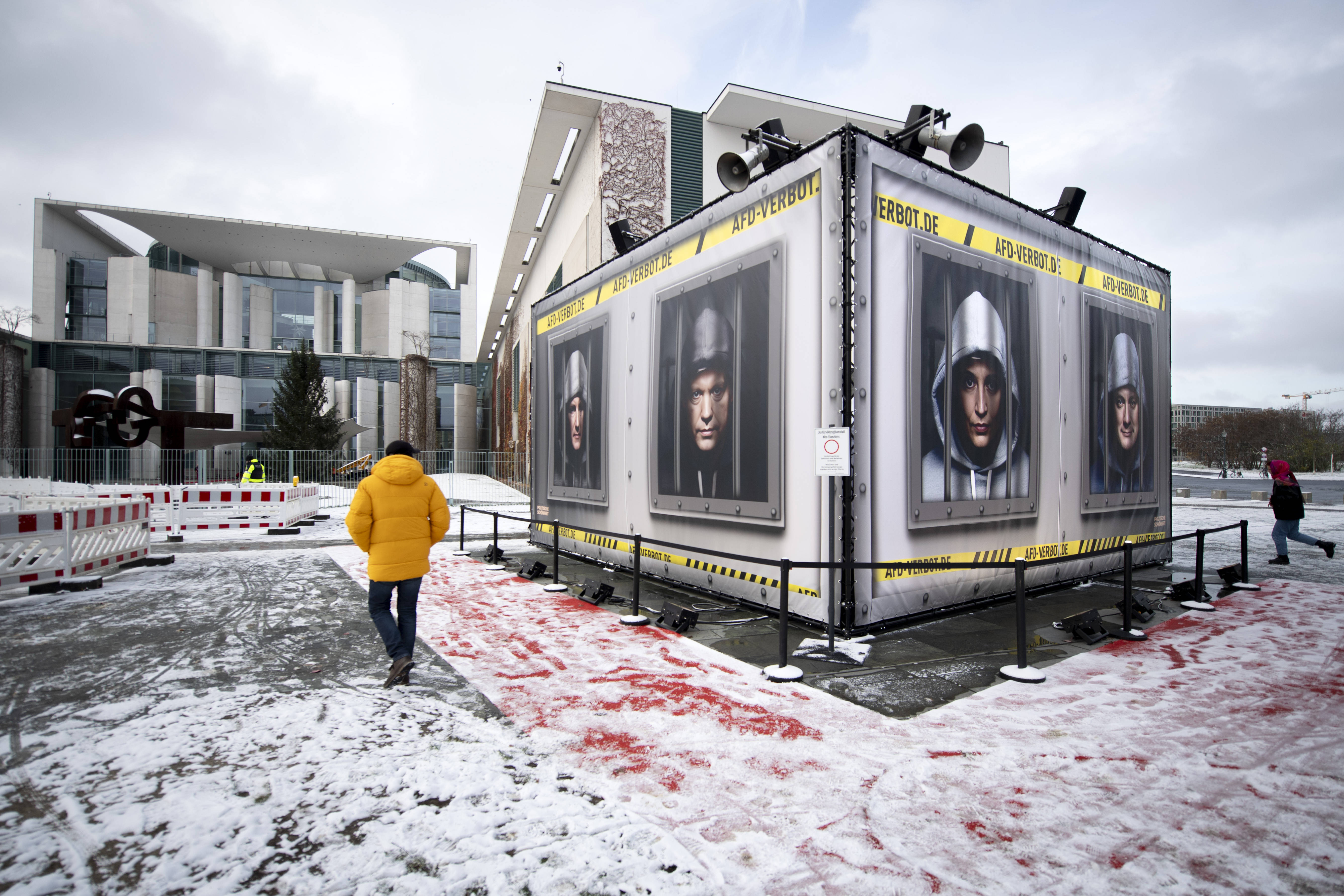
Berlin in the summer of 2025: Alice Weidel appears for an interview in the open air in German television. The group “Zentrum für politische Schönheit” (Center for Political Beauty) gives the TV moment – in a very literal sense – an unexpected twist: near the interview site on the banks of the Spree in Berlin, the artist collective plays loud music. This makes a conversation between the journalist and Weidel virtually impossible. This is not an isolated incident: the artist collective has staged actions targeting the AfD for years. For example, a replica of the Berlin Holocaust Memorial was erected in the vicinity of AfD politician Björn Höcke's home.
Art as a means of protest is often used to draw attention to social problems and injustices, for example climate change and its consequences. In 2022, for example, two members of the group “Letzte Generation” (Last Generation) glued themselves to a painting in the Städel Museum in Frankfurt am Main as a sign of disapproval of the “federal government’s deadly fossil-fuel policies” as the group described it at the time. Elsewhere, a piece of art was pelted with mashed potatoes.
How is artistic protest evaluated?
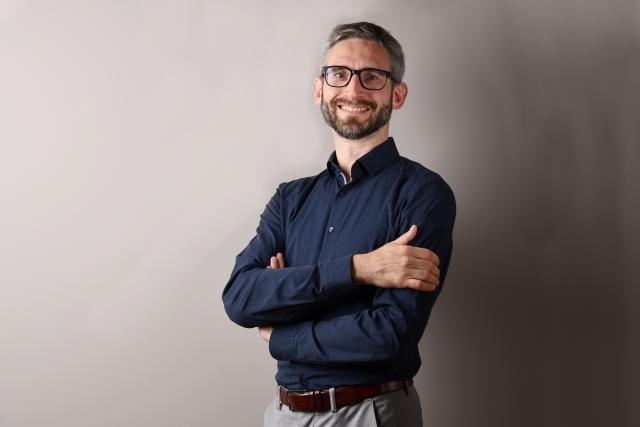
But what impact do these forms of protest have? Can they bring about change? How are such actions received by the public? This is precisely what Berend Barkela wants to know: In his research, he investigates the influence of artistic protest on the moral judgement towards protesters and their cause. Art can change perceptions, Barkela explains: "If you encounter a person dressed in dark clothing with a knife on the street at night, you will probably run away—you feel afraid. If the same scene is hanging on the wall in a museum, you stop, you're curious, you look at everything closely and think about it." Art thus opens spaces in which people can engage more positively with negative subjects. And art has a certain freedom to provoke. Barkela adds that freedom of artistic expression is widely regarded as a fundamental societal value. As such, art has always been an opportunity to criticize society and existing power structures.
Norm-violating protest: legitimate as art?
As a scientist, Berend Barkela wants to know whether attitudes toward disruptive protest—i.e., protest that violates norms—change when the protest is linked to artistic performance. He has approached this question in two studies. A total of 900 people took part in the first study. They were presented with fictional media reports about various protest actions and were then asked to evaluate them. “In the study, we presented six different forms of protest,” Barkela explains, “comparing artistic protest with non-artistic protest.” Both took different forms: peaceful, involving civil disobedience, and violence.
The non-artistic protest consisted of a sit-in blockade in the government district. A spokeswoman demanded that the federal government does more to protect the climate to meet the 1.5-degree target. She argued that only this would prevent species extinction, droughts, and famines.
The artistic protest also consisted of a sit-in blockade in the government district – but additionally a performance: some of the protesters represented endangered species that fell dead during the artistic action. A spokeswoman explained that this was to draw attention to the danger of species extinction due to climate change.
As part of the first escalation stage, “civil disobedience,” both forms of protest—non-artistic and artistic—also involved road blockings. In the next escalation stage, “violence,” both forms of protest included attacks on cars in addition to road blockings.
The study participants were then asked how immoral they considered the protesters' behavior to be. The results: disruption, i.e., protest that is not fully peaceful, is perceived as immoral and leads to less support – both for artistic and non-artistic protest. Berend Barkela: “In peaceful protests, artistic actions are even slightly more likely to be perceived as immoral than non-artistic actions.” The reason? Perhaps the study participants perceive the art as overly instrumentalized.
Moreover, the protesters may not even be recognized as artists. “To rule this out, we deliberately overemphasized this factor in the second study,” Berend Barkela explains. A total of 1,200 people took part in this second study, which was followed a similar design: However, the media reports presented to the participants made it explicitly clearl that the artistic protesters had indeed created art with their performance. For example, the activists were described as a well-known group of artists who had already exhibited in renowned museums. And in one of the media reports, an art historian was quoted describing the action as an artistic performance. Nevertheless, the results were rather mixed in this case as well, says Berend Barkela. “There is careful evidence that artistic protest is perceived as less immoral under certain conditions.” However, the different judgements were neither strong nor substantial.
How artistic protest works
What conclusions can be drawn from the studies? “Generally speaking, no matter how it is designed, the more violent a protest, the more negatively it is perceived.”
And—as Berend Barkela concludes from his findings—whether art is effective as a form of protest depends strongly on the target audience: “The less someone shares the political positions of the group, the more negative their perception will be.” For example: People with more conservative political orientation perceive disruptive climate protests as negative already at low levels of escalation.
Protesters can harm the cause
What does all this mean for art as a form of protest? “Other studies also show that radical, violent protests are detrimental to the cause itself.” The “Fridays for Future” movement, for example, has generated substantial public support for climate action. “They have not achieved all their demands. But they were perceived as a legitimate social movement and were portrayed quite positively in the media.” It was precisely this positive image that suffered when more militant forms of climate protest emerged. “That said, it cannot be ruled out that activists may still achieve their goals in this way, because the issue still receives attention and ends up on the political agenda one way or another.”
Getting attention – getting on the political agenda: From a research perspective, several factors are crucial in generating attention, including media coverage, for activists cause. One key factor is size. For example, by mobilizing large number of protesters. In addition, symbolic staging can spark public interest: chanting, coordinated clothing, or carefully staged performances—especially if they offer appealing visuals for television cameras and photographers.
Art needs to be contextualized
But apart from theatrical performances and loud actions, can something be achieved simply by showing pictures? For instance, also images displayed in a museum may reach a broad public audience. Berend Barkela addresses this question in his research as well: In another study, he compared the effect of two different types of images, a documentary photo and an abstract painting. Both depict a forest fire, thus addressing environmental issues and the climate crisis. A total of 580 participants viewed the forest fire photograph, while 575 test participants viewed the artwork. Then, they answered questions about emotions the images evoked in them. The result: compared to the photo, the painting received higher aesthetic ratings and evoked more positive emotions. It also reduced the perception of negative emotions.
But the painting also led to greater psychological distancing–in this case, greater distance from the issue of climate change. Contrary to what one might expect, it did not immediately motivate people into action nor did it directly increase their willingness to support change.
However, art can set a chain of causation in motion, adds Barkela: “Art puts people in a positive state of mind. And this, in turn, enables them to think about subjects differently. The crucial question then is how this state is guided and shaped.” In his view, this is precisely where museum curators and art educators come in: "It doesn't make sense to simply rush people through a museum. Art exhibitions should always be carefully curated and contextualized." This is an important insight for anyone who wants to inspire social change through powerful imagery.