Brussels, October 2025. At the EU Representation of North Rhine-Westphalia, researchers are meeting with politicians from across Europe for an unusual summit: the Loneliness Forum. They are discussing social isolation as a growing societal problem and its consequences for health, democracy and social cohesion. An EU-wide network has been tasked with collecting data and finding solutions.
For sociologist Leonie Steckermeier, this is not an abstract debate. While the issue of loneliness is being debated in Brussels, she is preparing a presentation for an adult education centre. The first slide features a simple sentence: “Good friends, good life.”
Steckermeier’s research has shown her how important friendships are for quality of life. She wants to share this knowledge not just at academic conferences, but with as many people as possible. “We often only talk about relationships when something goes wrong,” she says. “Yet they are so important for our well-being.”
Quality beats quantity
Steckermeier wants to understand what makes us healthy and happy. “Genuine friendships contribute greatly to our well-being,” she says. “We need people with similar interests to do things with. It’s important that we laugh together, experience beautiful things and simply enjoy spending time together. It’s not just about how many friends we have. What matters is the quality.”
In the age of social media, this finding seems almost contradictory. Never before has it been so easy to collect contacts and stay connected with hundreds of people at the same time.
“However, having lots of friends on social networks has absolutely no positive effect on one’s own well-being.”
“It doesn’t matter whether you have 500 followers or none," says Steckermeier.
The same applies in real life. Someone surrounded by many people can still feel lonely. “It’s entirely possible to be ‘lonely in a crowd’ – that is, lonely among many,” explains Steckermeier. “On the other hand, there are certainly people who have a best friend and never feel lonely.”
Therefore, the number of followers we have says little about the quality of our social relationships. Additionally, friendship is difficult for researchers to define. Unlike family or romantic relationships, it is not regulated. There is no certificate or contract, and no clear definition. Whether a relationship counts as a friendship is decided by the people involved.
Friendship in numbers
Steckermeier works with large datasets and international surveys. She examines how friendships are distributed across different countries, which groups have particularly many or few friends, and the role that friendship plays in life satisfaction.
“In sociology, we try to map society as completely as possible,” she explains. “We consider all age groups, different educational levels and incomes. Only then can we understand what role friendships play in society.” To this end, Steckermeier uses the European Values Survey, among other things. Since the 1980s, this Europe-wide study has examined which values people prioritise most in life. The data show that the importance of friendship also depends on where you live.
A look beyond borders
In Germany, for example, friendship has consistently ranked second for decades, right behind family. It also remains consistently important in Scandinavia. In many Eastern European countries, the importance of friendship has risen significantly in recent decades. “After the collapse of the socialist systems, many established structures broke down – neighbourhoods, workplaces and other collectives that used to organise social bonds,” says Steckermeier. “As a result, friends have become more important.”
A different picture emerges further south. In France and Italy, work is given greater importance than friendship in the surveys. “At first glance, this seems surprising because social life in these countries is considered particularly vibrant,” explains Steckermeier. “But economic uncertainty shifts priorities. When the overall quality of life is threatened – for example by an economic crisis — then the importance of work increases.”
When friendships become more important
Why friendship is valued differently across Europe also has to do with social changes. “Friendship didn’t always play the role it does today,” says Steckermeier. “Just a few decades ago, social ties often formed almost automatically: people grew up in their parents’ hometown, stayed there their whole lives, got married, had children and were embedded in their family, neighbourhood and work environment.”
These structures have changed. Today, many people move to other cities for training, college or work, often multiple times. Family and old networks are left behind. At the same time, starting a family is being postponed. This creates a longer phase at the beginning of adulthood in which friendships become particularly important.
When families are started, they tend to be smaller than in the past. “When fewer children are born, there are automatically fewer relatives,” says Steckermeier. “Then the number of relationships with aunts, uncles or cousins also decreases.” Rising life expectancy also means that the period after children have left home is longer. The void left by the departure of children is filled by friends — but not just any friends.
Birds of a feather flock together
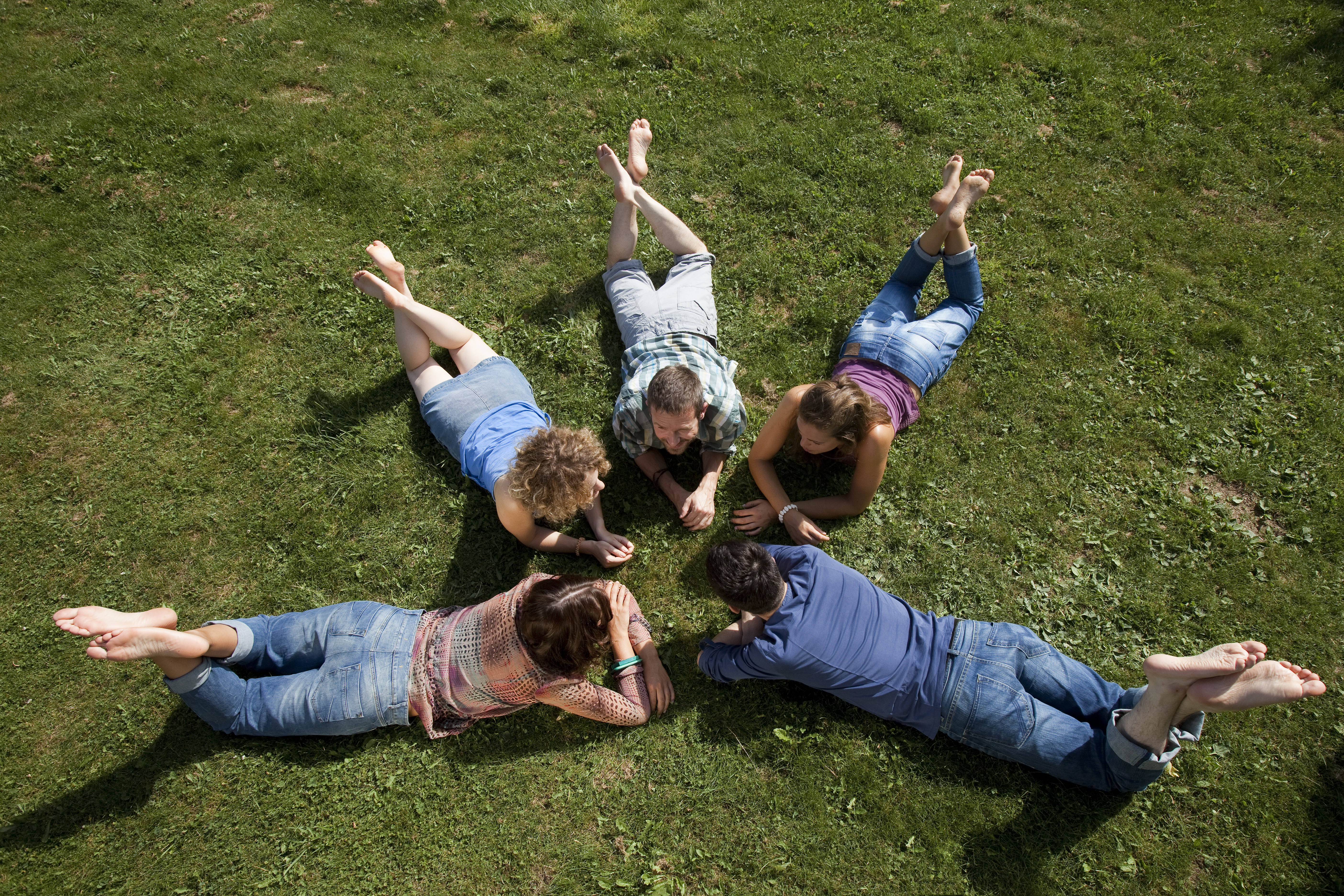
Take a look at your circle of friends and you’ll quickly spot patterns. Often, friends are around the same age, have a similar level of education, or share the same interests. Sociologists call this homophily: the tendency to form relationships with people who are similar to us.
Friendships develop where people regularly spend time together: at school, college, work or in a sports club, for example. “We meet people in places we’ve consciously chosen,” says Steckermeier. “And if someone has similar interests, there’s a greater chance that a friendship will develop.” If you join a football club, for example, you’ll meet people who like football. If you meet someone at college, they’ll probably have a similar educational background.
Sometimes, chance even plays a role. Studies show that students who sit next to each other at an orientation session are significantly more likely to become friends later on. “Friendships often simply develop where people spend time together,” says Steckermeier. “At the same time, the opportunities for meeting people have changed.”
In the past, there were more fixed social events, such as dances that almost everyone in the village attended. Today, the options are more diverse, ranging from sports clubs and board game groups to coffee tastings and online gaming. There are specific meeting places for almost every interest.
While this makes it easier to find like-minded people, it also makes things more complex. “While someone moving to a big city has more people to choose from, these people often already have an established circle of friends,” explains Steckermeier. “On top of that, life in the city is often more anonymous, so you first have to find the right people.” If you succeed, these relationships can shape your life for years. Studies have shown that older people with a large, well-connected circle of friends tend to live longer.
The network that endures
It is often in difficult times that the importance of friends becomes clear. “Studies show that a serious illness diagnosis frequently reactivates friendships. The circle of friends simply steps up again and says, ‘Hey, we’re still here!’” says Steckermeier. “This finding really made me happy.”
After her talks, people have told her that they experienced exactly that: an ill partner brought old friendships back to the surface — relationships that later helped them cope with loss and grief.
“Friendship isn’t a contract. But that’s exactly where its strength lies,” says Steckermeier. “Because it isn’t formalised, it can be revived even after years.” Friendships ebb and flow, cool off, and yet find their way back together. “It’s like an invisible net that remains.”
More data, please
Despite many studies, there are still major gaps in the research. Long-term data are particularly lacking regarding friendships in adulthood. Questions such as how expectations change over the course of a lifetime or what role economic crises play can only be partially answered so far.
For Leonie Steckermeier, this is motivation to keep going. She hopes that friendship will become a topic of discussion earlier on – in school, for example. “Because, of course, there are also negative aspects of friendships. If you expect a friend to be perfect all the time, it leads to conflict.” Through her lectures, she tries to share this knowledge.
To combat loneliness, Steckermeier advises spending as much time as possible with others. “According to a study by the University of Kansas, it takes around 50 hours for a casual friendship to develop, 90 hours for a genuine one, and 200 hours for a close friendship,” she says. “That sounds funny, but there’s definitely some truth to it.” She adds that it is also important to take advantage of existing opportunities to connect with others.
“Friendships don’t just happen by chance. They grow slowly, hour by hour, through shared experiences and mutual support.” Ultimately, it is precisely these hours spent together that give rise to something that carries many people through life – like an invisible net.